What Is the Orton-Gillingham Approach?
Learn what the Orton-Gillingham approach is and how it supports children with dyslexia and reading difficulties through structured, multisensory instruction. This parent-friendly guide is designed for families seeking reading intervention and dyslexia support in Amman, Jordan, including international and expat communities, and explains how individualized, evidence-based teaching helps students build lasting reading skills and confidence.
What Is the Orton-Gillingham Approach?
Families seeking reading support often encounter the term Orton-Gillingham approach when exploring tutoring, intervention, or specialist services. For parents—especially expat and international families navigating unfamiliar education systems—it can be difficult to know what this approach means and whether it is right for their child.
This article explains the Orton-Gillingham approach in clear, practical terms. It is written to support families who want to understand how evidence-based reading instruction works and how it can help children build strong, lasting literacy skills.
Understanding the Orton-Gillingham Approach
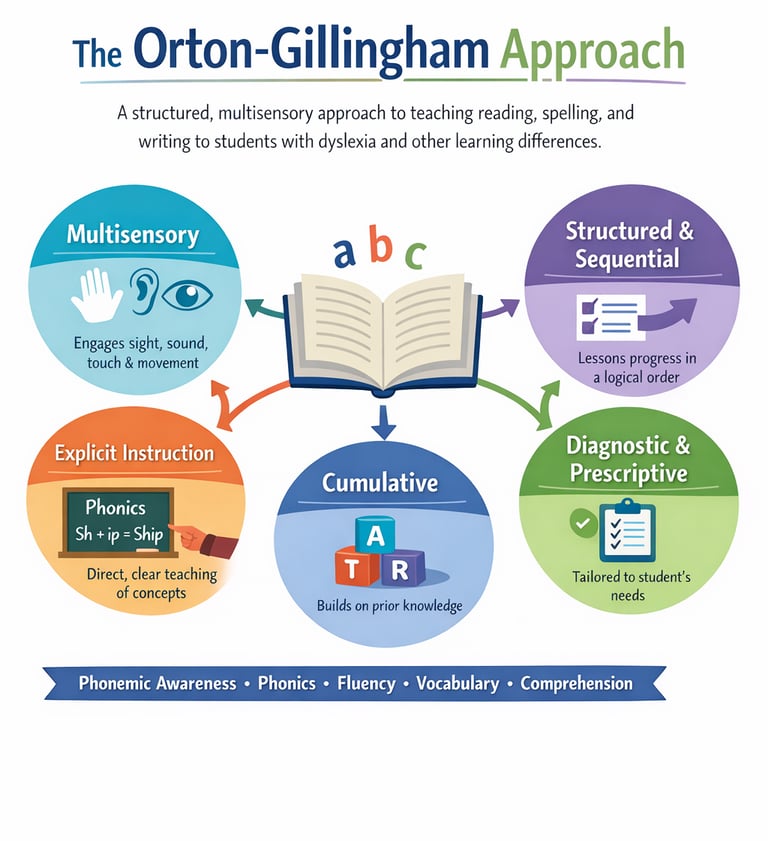
The Orton-Gillingham approach is an instructional framework for teaching reading, spelling, and written language. It is grounded in research on how the brain learns language and is designed to support students who need clear, structured instruction.
Importantly, Orton-Gillingham is not a single program or curriculum. Instead, it is a set of guiding principles that inform how instruction is planned and delivered. Many reading programs and tutors draw from Orton-Gillingham principles while adapting lessons to meet the needs of individual learners.
At its core, the Orton-Gillingham approach is:
Explicit – skills are taught directly and clearly
Systematic and sequential – concepts are introduced in a logical order
Multisensory – learning engages sight, hearing, speaking, and movement
Individualized – instruction is adjusted based on each student’s progress
This structured yet flexible framework helps ensure that students understand how written language works rather than relying on guesswork or memorization alone.
Key Characteristics of Orton-Gillingham Instruction
While lessons may look different from one instructor to another, effective Orton-Gillingham instruction shares several essential characteristics.
1. Explicit, Direct Teaching
In Orton-Gillingham instruction, reading skills are not assumed to develop naturally for all learners. Instead, teachers clearly explain and model each concept before asking students to practice.
For example, students are directly taught:
How sounds are produced in spoken language
How letters and letter patterns represent those sounds
How to apply this knowledge when reading and spelling words
This clarity reduces confusion and helps students understand the structure of language.
2. Systematic and Sequential Instruction
Skills are taught in a carefully planned sequence that builds from simple to more complex concepts. Each new skill is introduced only after earlier skills are secure.
Instruction typically progresses through:
Phonemic awareness
Phonics and sound-symbol relationships
Decoding (reading words accurately)
Encoding (spelling words correctly)
Language structure, including syllables, morphology, and sentence patterns
This step-by-step progression allows students to develop a strong foundation and reduces gaps in understanding.
3. Multisensory Learning
A defining feature of the Orton-Gillingham approach is multisensory instruction. Students learn by engaging multiple senses at the same time, which strengthens memory and supports deeper learning.
Multisensory techniques may include:
Seeing letters, words, and patterns
Hearing sounds and spoken language
Saying sounds and words aloud
Writing or tracing letters and words
By combining visual, auditory, and physical input, students form stronger connections between sounds and symbols—an especially helpful strategy for learners who struggle with traditional instruction.
4. Instruction in Both Reading and Spelling
Orton-Gillingham instruction addresses reading and spelling together because these skills reinforce one another.
Students receive direct instruction in:
Phonemic awareness – identifying and manipulating sounds in spoken words
Phonics – linking sounds to letters and letter patterns
Decoding – reading words accurately and efficiently
Encoding – spelling words using sound-symbol knowledge
Language structure – understanding how words are formed and used
Teaching reading and spelling in an integrated way helps students develop a more complete understanding of written language.
5. Individualized, Diagnostic Teaching
Rather than following a fixed script, Orton-Gillingham instruction is responsive to the learner. Teachers closely observe student performance and adjust lessons based on what the student needs next.
This means:
Skills are reviewed when necessary
Lessons move forward at an appropriate pace
Instruction targets specific areas of difficulty
This individualized approach is especially valuable for students who need additional practice or alternative strategies to master reading skills.
Why Orton-Gillingham Is Especially Helpful for Dyslexia
The Orton-Gillingham approach is widely recognized as effective for students with dyslexia and reading-based learning differences. Dyslexia affects how the brain processes language, often making phonemic awareness, decoding, and spelling more challenging.
Orton-Gillingham instruction directly addresses these challenges by:
Teaching sound-symbol relationships explicitly
Providing structured, repeated practice
Using multisensory techniques to strengthen learning pathways
While Orton-Gillingham does not remove dyslexia, it helps students develop the tools they need to read more accurately and confidently over time.
At the same time, many students without dyslexia also benefit from this approach. Children who have struggled with reading for other reasons often respond well to clear, structured instruction that fills in gaps and builds understanding step by step.
Common Misconceptions, Gently Explained
“Orton-Gillingham Is Only for Severe Dyslexia.”
Although the approach is especially helpful for students with dyslexia, it is not limited to one diagnosis. Any student who benefits from explicit, structured instruction can make progress with Orton-Gillingham-informed teaching.
“Orton-Gillingham Is a Scripted Program.”
Orton-Gillingham is not a single curriculum or set of scripted lessons. It is a framework that guides instruction. Effective teaching depends on a knowledgeable instructor who understands how to apply the principles thoughtfully and responsively.
reassurance for Families
Learning to read can be challenging for some children, but difficulty does not mean failure. The Orton-Gillingham approach provides a clear, structured way to teach reading that supports understanding, accuracy, and confidence.
When instruction is explicit, systematic, multisensory, and individualized, students are given the time and tools they need to succeed. With consistent support and thoughtful teaching, many learners develop not only stronger reading skills but also renewed confidence in themselves as readers—skills that serve them well for years to come.